Pros, Cons, and Practical Choices for SARC
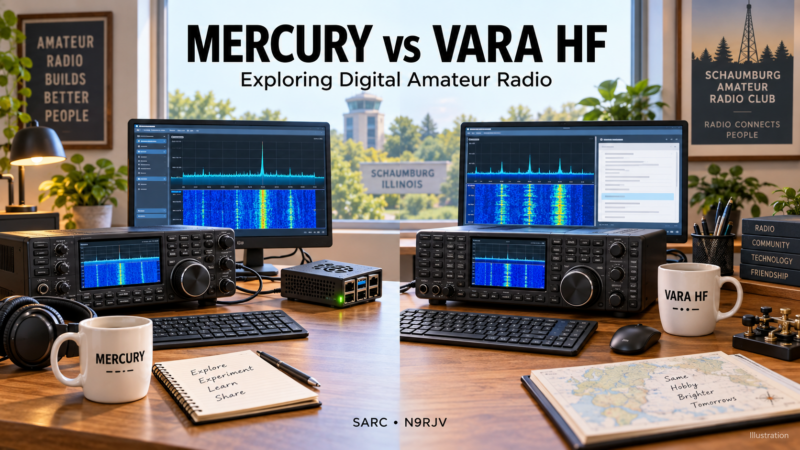
Here is a useful operating idea for Schaumburg Amateur Radio Club members: explore two ways to send messages and files over HF radio. Mercury and VARA HF offer an opportunity to learn about digital communications, compare station setups, and help newer hams make their first data connection.
The practical starting point is your intended contact. If that station uses VARA HF, choose VARA HF. If you and a partner want to explore an open-source modem, Mercury is worth a coordinated trial. The distinction between software compatibility and radio compatibility explains why.
Topic Snapshot
| Subject | Mercury VS VARA |
|---|---|
| Post idea from | Paul Meyes — KE9EJX |
| Audience | SARC members, visitors, new hams, the public, operators, and volunteers |
| Focus | HF messaging, file transfer, Winlink considerations, and peer-to-peer experiments |
| Suggested activity | A paired station demonstration followed by repeatable comparison tests |
| Review date | September 18, 2026. Check official documentation before installing or purchasing software. |
| Scope | This comparison concerns VARA HF. VARA FM and VARA SAT are separate products.[1] |
What Do These Modems Do?
A software modem converts computer data into audio that a radio can transmit. At the other station, another modem decodes the received audio. HF means high frequency; these programs use a suitable single-sideband, or SSB, radio and an audio connection.
Both Mercury and VARA HF use orthogonal frequency division multiplexing, or OFDM. In simple terms, information travels on multiple closely spaced carriers. Sharing that general technique does not make their radio signals interchangeable.[2] [1]
Mercury also documents automatic repeat request, or ARQ: the receiving station acknowledges data, and unsuccessful transfers can trigger another attempt. Its connected link takes turns transmitting and adjusts payload modes as conditions change.[3]
Mercury and VARA HF: The Main Tradeoffs
| Consideration | Mercury | VARA HF |
|---|---|---|
| License and cost | Free, open-source software with a GPL-3.0 project license.[4] | Proprietary software with a restricted free mode and a paid license for higher speeds. Check current terms with the developer.[1] |
| Operating systems | The project documents Linux, Windows, macOS, and Raspberry Pi support. Installation depends on the operating system and processor.[5] | A Windows modem. Linux operation can use Wine, a Windows compatibility layer; Pat documents that approach.[6] |
| Application connection | Provides a VARA-style command and data interface, with some commands accepted without implementing the corresponding feature.[7] | Explicitly supported by Winlink Express and used by VarAC.[8] [9] |
| Software development | Members can inspect the code and contribute under its license.[4] | Changes to the modem depend on its developer; it is not an open-source project.[1] |
| Suggested club use | Coordinated experiments, native platform trials, and learning how a modem works. | Contacts and exercises whose destination already requires VARA HF. |
Mercury: What Works in Its Favor?
Mercury is developed by Rhizomatica as part of its HERMES project. Native support across several operating systems gives members flexibility when choosing a computer for their station.[5]
Its open-source license also creates a useful learning opportunity. A technically curious member can inspect an implementation, suggest improvements, or contribute a fix. For a club workshop, that makes software development part of the radio experiment.[4]
Meanwhile, Mercury’s release history shows work on audio handling, radio keying, client connections, and its graphical interface. Recent releases include chat-related improvements. Check the documentation for the exact release you install.[10]
Where Mercury Needs Careful Planning
Mercury needs a compatible Mercury station at the far end. Changing your local modem does not convert a VARA-only gateway into a Mercury gateway. That follows from Mercury’s own radio protocol and its separate VARA-style application interface.[3]
In addition, active development means instructions and behavior can change between releases. Recent fixes involving Pat connections and audio devices are good reasons to record both stations’ versions and repeat a short test after updating.[10]
VARA HF: What Works in Its Favor?
VARA HF has a clearly documented role in existing applications. Winlink Express lists it as a supported radio mode. VarAC provides a separate application for conversations and other messaging features over VARA.[8] [9]
Consequently, VARA is a practical starting choice when your intended gateway or operating partner already uses it. You can focus the first session on setting up audio, making a connection, and completing a message exchange.
Where VARA HF Has Tradeoffs
Its proprietary license limits opportunities to inspect or modify the modem. Higher-speed operation also involves paid registration. Confirm current licensing details on the developer’s website before buying.[1]
Linux users should plan for an additional compatibility layer. Pat can run natively on Linux, but that does not make the VARA modem itself a native Linux application. Raspberry Pi installations require particular attention to the instructions for their processor and operating system.[6] [1]
Compatibility: Check All Three Layers
Mercury provides a TCP TNC interface: a network connection through which an application controls a terminal node controller, implemented here in software. Its documented defaults are port 8300 for commands and 8301 for data. TCP stands for Transmission Control Protocol.[7]
However, matching commands is only one part of a working connection. For example, Mercury’s command reference says its compression command is acknowledged without enabling modem compression. Treat compatibility as something to verify with your chosen application and release.[7]
| Layer | Question to answer |
|---|---|
| Application to modem | Can the client control this modem and exchange data through the configured ports? |
| Radio link | Are both stations using compatible modem protocols, releases, and bandwidth settings? |
| Message service | Do both ends support the intended email, chat, or file-transfer application? |
What About Winlink Express, Pat, and VarAC?
Winlink Express and Pat both document VARA support. Mercury’s interface makes integration possible, but a successful local client connection does not establish access to a remote Winlink gateway. Confirm Mercury support at the destination before attempting a Mercury session.[8] [6] [7]
Similarly, VarAC and VARA are different programs. VarAC supplies the user-facing chat experience; VARA supplies the modem. VarAC’s published prerequisites identify VARA HF or VARA FM. Mercury release notes mention VarAC beacon support, but that alone does not establish complete compatibility with every VarAC feature.[9] [11] [10]
Which One Should You Try First?
Start with the destination and work backward. This decision guide applies the compatibility checks above.
flowchart TD
    A["Choose a contact or gateway"] --> B{"Destination requires VARA HF?"}
    B -->|Yes| C["Use VARA HF"]
    B -->|No| D{"Mercury partner confirmed?"}
    D -->|Yes| E["Match Mercury releases and settings"]
    D -->|No| F["Arrange a compatible partner"]
    F --> A
    C --> G["Check client, audio, and radio keying"]
    E --> G
    G --> H["Exchange a short test message"]
Performance: Measure the Completed Message
Claims that Mercury always matches or beats VARA HF go beyond what the documentation reviewed here establishes. Mercury publishes mode-level measurements under specified simulated conditions. Those measurements are useful, but they do not establish a universal winner against VARA on real radio paths.[2]
For a useful comparison, distinguish the displayed modem rate from goodput: the useful information delivered per unit of time. Connection setup, acknowledgments, retries, and changing conditions affect the completed transfer. Mercury’s documentation explicitly distinguishes payload rates from ARQ goodput.[2]
Also record signal-to-noise ratio, or SNR, which compares signal strength with background noise. Treat readings from different programs cautiously unless their measurement methods and reference bandwidths match.
A Suggested SARC Comparison Test
- Keep the station arrangement consistent. Use the same two stations, antennas, band, and comparable occupied bandwidth. Record transmitter settings and actual power measurements where available.
- Record the software. Include the application, modem release, operating system, and whether VARA is registered or operating with free-mode restrictions.
- Send identical content. Begin with a short text message, then try a modest file. Record any compression settings.
- Alternate the order. Run Mercury, then VARA, and reverse that order on the next pair of trials. Repeat in both directions to reduce the influence of changing conditions.
- Count failures too. Record unsuccessful connections, incomplete transfers, and manual intervention. Check that the received content matches the original.
| Measurement | Why record it? |
|---|---|
| Connection success | Shows how often a usable session begins. |
| Time to complete | Measures from the connection attempt to confirmed delivery. |
| Correct delivery | Checks the text or compares a file checksum, a compact fingerprint of its contents. |
| Operator effort | Records configuration problems, restarts, and recovery steps. |
Present the results as observations from those stations and conditions. A small club trial can guide local choices without proving that one modem is best everywhere.
How to Participate
Begin by telling a potential test partner which computer you plan to use and whether your goal is email, chat, or file transfer. Then agree on the modem, application, and software versions.
For a station demonstration, prepare a suitable HF radio, antenna, computer, radio audio connection, and the required cables. Follow the radio and modem instructions for audio levels and push-to-talk, or PTT, which switches the transmitter on. Mercury documents several PTT methods; the appropriate choice depends on your interface.[5]
Ask an experienced operator to help select an appropriate frequency and station settings. Listen before transmitting, begin with a short exchange, and keep notes. Visitors can follow the decoded messages or record results while the station operator handles the radio.
Suggested SARC Goals
| Participant | Suggested goal | Useful result |
|---|---|---|
| New hams | Trace a message from the application through the modem to the receiving station. | Explain the difference between the application and the radio protocol. |
| Visitors and the public | Observe a message exchange and ask how the stations connect. | See a practical example of digital amateur radio. |
| Linux and Raspberry Pi users | Try Mercury on a supported setup with a confirmed partner. | Write a repeatable installation and configuration checklist. |
| Winlink and chat operators | Confirm the destination’s requirements before changing modems. | Complete the intended message workflow. |
| Emergency communications volunteers | Practice a short exercise message using the group’s agreed software. | Document delivery, recovery, and operator handoff. |
| Technical members and helpers | Run paired tests and help others reproduce the setup. | Share measurements and clear troubleshooting notes. |
Give It a Try
Choose one achievable goal: send a short message, complete a file transfer, or help another member understand the station. Mercury offers an interesting path for experimentation, while VARA HF remains the appropriate choice for destinations using VARA.
Bring your questions and a willingness to compare notes. Share which computer you use, what you want to send, and what worked. Those practical details can help the next SARC member get on the air with confidence.
References
- VARA Modem and VARA HF Information; VARA HF Modem, including developer replies. José Alberto Nieto Ros, EA5HVK. Accessed September 18, 2026. https://rosmodem.wordpress.com/; https://rosmodem.wordpress.com/2017/09/03/vara-hf-modem/ ↩
- Mercury FreeDV Data Modes. Rhizomatica, Mercury project documentation. Accessed September 18, 2026. https://github.com/Rhizomatica/mercury/blob/mercuryv2/docs/MODES.md ↩
- ARQ Datalink: Architecture and Protocol Reference. Rhizomatica, Mercury project documentation. Accessed September 18, 2026. https://github.com/Rhizomatica/mercury/blob/mercuryv2/docs/ARQ.md ↩
- Mercury Project License: GNU General Public License, Version 3. Rhizomatica repository; license text by the Free Software Foundation. Accessed September 18, 2026. https://github.com/Rhizomatica/mercury/blob/mercuryv2/LICENSE ↩
- Mercury: HERMES HF Modem. Rhizomatica. Accessed September 18, 2026. https://github.com/Rhizomatica/mercury ↩
- Pat: A Modern Winlink Client. Pat project, Martin Hebnes Pedersen and contributors. Accessed September 18, 2026. https://getpat.io/ ↩
- Mercury TNC Command Reference. Rhizomatica, Mercury project documentation. Accessed September 18, 2026. https://github.com/Rhizomatica/mercury/blob/mercuryv2/docs/TNC.md ↩
- Winlink Express. Winlink Global Radio Email, Amateur Radio Safety Foundation, Inc. Accessed September 18, 2026. https://winlink.org/WinlinkExpress ↩
- VarAC: HF/FM/SAT Digital Chat. VarAC, Irad Deutsch, 4Z1AC. Accessed September 18, 2026. https://www.varac-hamradio.com/ ↩
- Mercury Releases. Rhizomatica. Accessed September 18, 2026. https://github.com/Rhizomatica/mercury/releases ↩
- Download VarAC: Windows/Linux Prerequisites. VarAC, Irad Deutsch, 4Z1AC. Accessed September 18, 2026. https://www.varac-hamradio.com/download ↩