
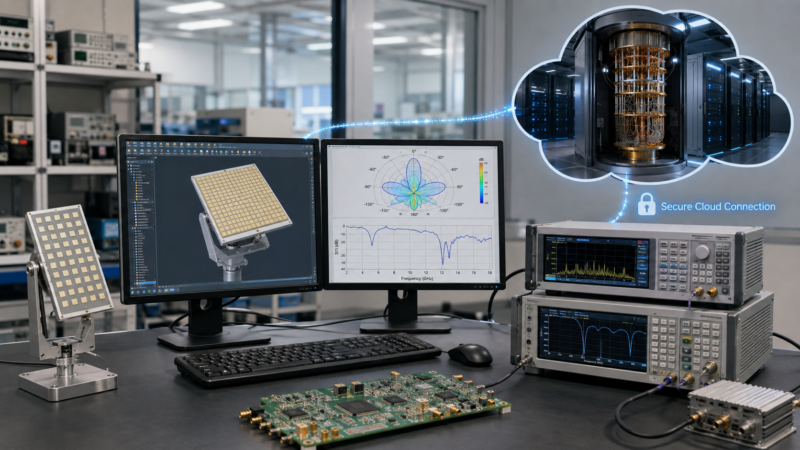
Could Quantum Computing Change Radio and Antenna Designs?
Here is a forward-looking technology question for SARC members: could quantum computing eventually change the way engineers design radios, antennas, filters, and digital communication systems?
IBM and several research partners recently reported three quantum-computing results that they say reached beyond leading classical methods while adding new ways to build confidence in the answers. That is an important research claim. However, it is not an announcement of a quantum transceiver, a faster FT8 decoder, or a new antenna for the amateur bands.[1]
For amateur radio, the useful question is not whether every station will contain a quantum processor. The better question is where quantum tools might eventually help engineers solve unusually difficult design, simulation, optimization, materials, and security problems.
Topic Snapshot
| Item | Details |
|---|---|
| Subject | Quantum Computing and Radio Design |
| Post idea from | Paul Meyers – KE9EJX |
| Audience | SARC members, visitors, new hams, the public, and operators |
| Starting source | IBM Claims Quantum Advantage With New Validation Techniques, IEEE Spectrum |
| Main question | Will quantum computing change radio designs? |
| Practical status | Promising research, but no immediate change is required for a typical amateur station |
Start With the Claim, Not the Hype
What is quantum advantage?
A classical computer stores information in bits that have a value of 0 or 1. A quantum computer uses quantum bits, or qubits. Qubits can be prepared in superpositions and linked through entanglement. Quantum algorithms use those properties, plus interference and measurement, to solve certain kinds of problems in a different way.
This does not mean a quantum computer tries every answer at once and then reveals the best one. It also does not mean quantum computers are faster for every job. The National Institute of Standards and Technology (NIST) explains that quantum and classical computers are expected to work together, with quantum machines serving specialized tasks rather than replacing ordinary computers.[6]
Quantum advantage generally means that a quantum computer performs a particular calculation beyond the practical reach of the best-known classical methods. The exact boundary can move when classical algorithms improve. Therefore, advantage is better treated as an evidence-based comparison than as a permanent finish line.
Why validation matters
If a classical supercomputer cannot reproduce a quantum result, how can researchers know that the quantum machine calculated the right answer instead of producing noise?
IBM’s three reported results address that trust problem in different ways. The methods include error-detecting circuit structure, comparisons at smaller sizes, deliberate changes in noise, independent error-mitigation methods, and tests on different quantum hardware. IBM describes the collection as evidence for trusted computation beyond exact classical verification.[2]
What IBM and Its Partners Reported
| Research team | What was calculated | How confidence was built | Why it matters |
|---|---|---|---|
| IBM and the University of Chicago | A depth-70 circuit with 70 logical qubits and 468 logical T gates, encoded across 97 physical qubits with error detection | The circuit’s structure and measured error syndromes produced a fidelity lower bound of 0.284 at 95% confidence | It combines a classically difficult calculation with a built-in certificate of execution quality.[3] |
| IBM, Qedma, RIKEN, BlueQubit, and collaborators | Driven magnetic-system behavior, called Floquet dynamics, in systems as large as 74 qubits | Researchers compared independent error-mitigation methods, checked smaller cases classically, and reproduced selected behavior on Quantinuum hardware | It offers evidence that a noisy quantum processor can act as a scientific instrument where leading classical simulations become unreliable.[4] |
| IBM, Algorithmiq, and collaborators | A 56-qubit model that follows how information spreads through a nonuniform quantum system | The team compared smaller, classically tractable cases and varied processors, gate calibrations, and injected noise | It tests whether the computation process can be validated when no exact classical answer is available.[5] |
A physical qubit is a hardware element. A logical qubit is an encoded computational unit built with physical qubits and an error-handling structure. A T gate is a quantum-logic operation that makes this type of circuit harder to simulate classically.
Fidelity measures how closely the produced quantum state matches the intended state. The Chicago experiment detected errors and rejected affected runs through a process called post-selection. It was not a fully fault-tolerant universal quantum computer.
The following graph shows the three system sizes highlighted in IEEE Spectrum’s description of the Qedma comparison. At 35 qubits, the quantum and classical approaches produced the same general oscillating pattern. At 51 qubits, the leading classical methods held only for the first few pulses before breaking down. The 74-qubit case was outside the reach of those classical approaches.
---
config:
  theme: base
  themeVariables:
    xyChart:
      titleColor: "#000000"
      dataLabelColor: "#000000"
      xAxisLabelColor: "#000000"
      xAxisTitleColor: "#000000"
      xAxisTickColor: "#000000"
      xAxisLineColor: "#000000"
      yAxisLabelColor: "#000000"
      yAxisTitleColor: "#000000"
      yAxisTickColor: "#000000"
      yAxisLineColor: "#000000"
  xyChart:
    width: 960
    height: 560
    chartOrientation: vertical
    titleFontSize: 20
    titlePadding: 18
    showDataLabel: true
    showDataLabelOutsideBar: true
    plotReservedSpacePercent: 60
    xAxis:
      labelFontSize: 13
      labelPadding: 10
      labelRotation: -15
      titleFontSize: 16
      titlePadding: 10
    yAxis:
      labelFontSize: 14
      labelPadding: 8
      labelRotation: 0
      titleFontSize: 16
      titlePadding: 8
---
xychart-beta
    title "Qedma Comparison Reported by IEEE Spectrum"
    x-axis "Comparison Stage" ["Methods agree", "Classical limit appears", "Largest quantum case"]
    y-axis "Qubits" 0 --> 80
    bar [35, 51, 74]
There is an important caution. When IEEE Spectrum published its report, all three papers were preprints and had not completed peer review. An independent researcher quoted by IEEE considered the work valuable but questioned whether the Qedma and Algorithmiq studies established a clear quantum advantage.
Their evidence showed that the tested classical methods struggled, but that is not necessarily the same as proving that every possible classical approach must fail.[1]
The University of Chicago method also paid a large price for its error checks. IEEE Spectrum reported that rejecting runs with detected errors required about 860 times more runs than the unchecked version. That overhead is one reason to avoid treating a successful research benchmark as an immediate practical application.[1]
That distinction is healthy science. These results should be examined, reproduced, and challenged as classical and quantum methods improve.
How Could Quantum Computing Change Radio Design?
The honest answer is possibly, in specialized radio-frequency (RF) engineering workflows. The change is more likely to appear first in research laboratories, cloud computing services, and commercial design software than inside a home transceiver.
| Radio area | Possible quantum contribution | Present reality |
|---|---|---|
| Electromagnetic simulation | Help solve selected large field-analysis problems used in antennas, waveguides, resonators, filters, and photonic structures | A peer-reviewed 2026 paper presented a quantum algorithm for Maxwell-equation field analysis and a proof-of-concept metalens simulation. It did not demonstrate a finished amateur-radio design tool or a practical speed advantage.[7] |
| Antenna and array optimization | Search difficult combinations of element locations, dimensions, matching choices, or competing design goals | Researchers have proposed quantum methods for antenna-array thinning. This is early design research, not a replacement for Numerical Electromagnetics Code (NEC) modeling, a vector network analyzer, or on-air testing.[8] |
| Materials and components | Model quantum materials that could lead to improved semiconductors, magnetic devices, sensors, resonators, or low-loss components | The new IBM studies concern abstract quantum-material models. Any path from those calculations to better radio parts would require materials research, fabrication, testing, and product development. |
| Software-defined radio | Assist with narrowly defined optimization, channel estimation, detection, or coding problems | CPUs, GPUs, digital signal processors, and field-programmable gate arrays remain the practical tools for amateur SDR and digital modes. A proposed quantum algorithm must still beat the best classical method after data-loading and measurement costs are counted. |
| Security and firmware | Encourage quantum-resistant software for connected radios, update servers, remote-station control, and signed firmware | NIST has already published three post-quantum cryptography standards. These are classical algorithms designed to resist future quantum attacks; they do not require a quantum radio.[9] |
Electromagnetic modeling may be the clearest design connection
Radio engineers already use computers to solve Maxwell’s equations for complex structures. A model may contain many conductors, materials, frequencies, angles, and constraints. Each added detail can increase the computational cost.
A future quantum-assisted solver might accelerate a carefully chosen part of that workload. However, the engineer would still need to define the geometry, choose assumptions, interpret the output, and compare the model with measurements.
Optimization could help with large design spaces
A simple dipole does not need a quantum computer. Its dimensions can be estimated, modeled, built, trimmed, and measured with familiar tools.
A much larger problem is different. Imagine selecting hundreds of array-element positions while balancing gain, sidelobes, bandwidth, cost, weight, and failure tolerance. That is the kind of combinatorial search where researchers are testing quantum and hybrid algorithms.
New materials could affect radios indirectly
Quantum computers are naturally suited to some simulations of quantum systems. If they help researchers understand useful materials, the eventual radio benefit could arrive as a better component rather than as a visible quantum computer.
That path is long. A promising calculation is only the beginning. The material must still be created, characterized, manufactured, and proven reliable.
Security changes are already more practical
Post-quantum cryptography may matter to the Internet-connected side of amateur radio. Examples include protecting account logins, authenticating software updates, signing firmware, and securing remote-control links that use ordinary Internet services.
That does not create permission to hide the meaning of amateur-radio traffic. Current Federal Communications Commission (FCC) rules generally prohibit amateur stations from transmitting messages encoded for the purpose of obscuring their meaning, except where Part 97 provides otherwise.
Operators should check the current rules before putting any encrypted or experimental encoded system on the air.[10]
What Probably Will Not Change
- Maxwell’s equations will still govern electromagnetic waves.
- Antenna length, impedance, feed-line loss, common-mode current, noise, and propagation will still matter.
- A simulation will still need real measurements and engineering judgment.
- Most station-control, logging, digital-mode, and SDR work will continue to run well on classical computers.
- Amateur operators will still need to follow FCC rules, band plans, and good operating practice.
- Hands-on building and troubleshooting will remain valuable club skills.
Quantum computing may add a specialized tool to the engineering bench. It will not repeal radio physics or replace the operator.
A Realistic Hybrid Workflow
The most plausible future is a hybrid process. A classical computer handles the user interface, data preparation, ordinary calculations, and final analysis. A quantum processor receives only a carefully selected subproblem.
---
config:
  markdownAutoWrap: true
  flowchart:
    wrappingWidth: 220
    useMaxWidth: true
    nodeSpacing: 40
    rankSpacing: 50
---
flowchart TD
    A["`Choose a difficult
RF design question`"]

    B["`Build and simplify
a classical model`"]

    C["`Send a suitable subproblem
to a quantum processor`"]

    D["`Return the measurements
to classical software`"]

    E["`Compare the results
with classical methods`"]

    F["`Build and measure
the real hardware`"]

    G{"`Do the measurements
support the design?`"}

    H["`Keep and document
the result`"]

    A --> B
    B --> C
    C --> D
    D --> E
    E --> F
    F --> G

    G -->|"Yes"| H
    G -->|"No"| A
How to Participate
- Read the IEEE Spectrum report. Notice both IBM’s claims and the independent cautions.
- Learn five terms. Start with bit, qubit, superposition, entanglement, and quantum advantage.
- Try a small circuit online. IBM Quantum Learning provides introductory courses and a visual circuit composer. Platform access and features can change, so check the official site for current details.[11]
- Connect the topic to radio. Choose one familiar problem, such as antenna-array element selection or filter optimization, and identify what the inputs, constraints, and measurable output would be.
- Keep three evidence labels. Mark each claim as demonstrated, proposed, or speculative.
- Share what you learn. Bring a short explanation, paper, notebook, or conventional comparison to a SARC discussion.
Questions Worth Asking
- Was the result produced on quantum hardware, a simulator, or both?
- What is the best-known classical comparison?
- How was the result checked when an exact answer was unavailable?
- Were data-loading, error-correction, repeated-run, and readout costs included?
- Does the work solve a practical RF problem or only a useful benchmark?
- Has the paper completed independent peer review?
- Can another research group reproduce the result?
Suggested SARC Goals
| Member type | Suggested goal | Useful result |
|---|---|---|
| New ham or visitor | Learn the difference between a classical bit and a qubit | Explain quantum advantage in two plain-language sentences |
| Active operator | List station tasks that need fast computing today | Separate practical DSP needs from possible future quantum use |
| Antenna builder | Model a familiar antenna with conventional software | Identify which parts are physics, optimization, and measurement |
| SDR or software member | Run a beginner quantum circuit and inspect repeated measurements | Understand why quantum output is statistical and needs validation |
| Technical presenter | Compare one quantum research claim with its classical baseline | Give SARC a balanced five-minute update |
| Club project team | Track one RF-related quantum paper for a year | Record whether it is peer reviewed, reproduced, improved, or challenged |
Give It a Try
Quantum computing gives SARC members another reason to explore the physics and engineering behind radio. Start small. Read the source, learn the vocabulary, try one simple circuit, and keep the claims tied to evidence.
Will quantum computing change radio designs? It may eventually improve selected simulations, optimization methods, materials research, and security tools. For now, its most useful role in amateur radio is as a learning topic and a reminder that every impressive calculation still needs verification.
Bring your questions and discoveries to SARC. New hams, experienced builders, programmers, and curious visitors can all take part.
Will quantum computing change radio designs?
Read the IEEE Spectrum report, try one beginner quantum-computing lesson, and bring one practical RF question to SARC.
References
- Edd Gent, “IBM Claims Quantum Advantage With New Validation Techniques,” IEEE Spectrum, IEEE, July 31, 2026. Accessed August 13, 2026. https://spectrum.ieee.org/ibm-verifiable-quantum-advantage ↩ ↩ ↩ ↩
- Abhinav Kandala, Ali Javadi-Abhari, and Jay Gambetta, “Researchers Demonstrate Quantum Advantage Through Trusted Quantum Computation,” IBM Quantum Blog, IBM, July 30, 2026. Accessed August 13, 2026. https://www.ibm.com/quantum/blog/quantum-advantage ↩
- Simon Martiel et al., “Sampling Hard Circuits With Verifiably High Fidelity,” arXiv:2607.25941, submitted July 28, 2026. Accessed August 13, 2026. https://arxiv.org/abs/2607.25941 ↩
- Eyal Leviatan et al., “Resolving Structure in Prethermal Floquet Dynamics With Precision Quantum Computation,” arXiv:2607.24937, submitted July 27, 2026. Accessed August 13, 2026. https://arxiv.org/abs/2607.24937 ↩
- Samantha V. Barron et al., “Observable Estimation in the Absence of Classical Verification,” arXiv:2607.25998, submitted July 28, 2026. Accessed August 13, 2026. https://arxiv.org/abs/2607.25998 ↩
- Gabriel Popkin, “Quantum Computing Explained,” National Institute of Standards and Technology, created March 18, 2025, updated May 28, 2026. Accessed August 13, 2026. https://www.nist.gov/quantum-information-science/quantum-computing-explained ↩
- Hiroyuki Tezuka and Yuki Sato, “Quantum Algorithm for Electromagnetic Field Analysis,” International Journal for Numerical Methods in Engineering, Wiley, 2026, DOI: 10.1002/nme.70344. Accessed August 13, 2026. https://doi.org/10.1002/nme.70344 ↩
- Paolo Rocca, Nicola Anselmi, Giacomo Oliveri, Alessandro Polo, and Andrea Massa, “Antenna Array Thinning Through Quantum Fourier Transform,” IEEE Access, volume 9, 2021, pages 124313–124323, DOI: 10.1109/ACCESS.2021.3109938. Accessed August 13, 2026. https://doi.org/10.1109/ACCESS.2021.3109938 ↩
- National Institute of Standards and Technology, “Announcing Approval of Three Federal Information Processing Standards for Post-Quantum Cryptography,” NIST Computer Security Resource Center, August 13, 2024. Accessed August 13, 2026. https://csrc.nist.gov/news/2024/postquantum-cryptography-fips-approved ↩
- Electronic Code of Federal Regulations, “47 CFR § 97.113—Prohibited Transmissions,” Office of the Federal Register and U.S. Government Publishing Office, current page viewed August 13, 2026. https://www.ecfr.gov/current/title-47/chapter-I/subchapter-D/part-97/subpart-B/section-97.113 ↩
- IBM, “Learn Quantum Computing,” IBM Quantum Learning. Accessed August 13, 2026. https://quantum.cloud.ibm.com/learning/en ↩