Updated July 11, 2026: This article has been expanded and corrected after review of FCC Authorization and Order DA 26-391 and follow-up guidance from ARRL and the International Amateur Radio Union.
On April 21, 2026, the Federal Communications Commission issued an authorization and order for AST & Science, LLC, the operator of AST SpaceMobile. The action granted authority for 223 additional low-Earth-orbit satellites, bringing the company’s authorized constellation to 248 satellites.
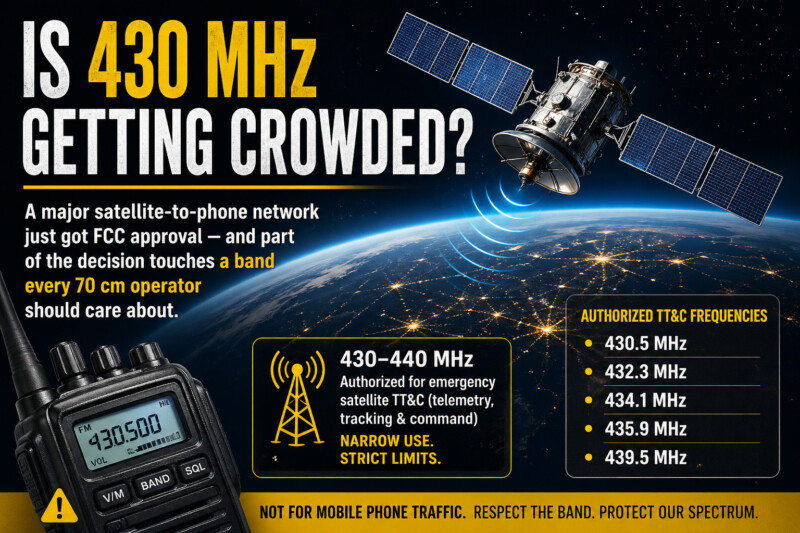
One part of the order deserves the amateur-radio community’s attention: tightly limited authority to use five narrow channels in the 430–440 MHz portion of the 70-centimeter band for emergency telemetry, tracking and command, commonly abbreviated
TT&C.
That may sound like 430 MHz is becoming a cellphone band. It is not. The details matter.
What the authorization does—and does not—allow
AST SpaceMobile is developing a satellite system intended to connect compatible, ordinary mobile phones in places where terrestrial service is poor or unavailable. In the United States, the direct-to-cell service uses licensed commercial cellular spectrum in the 700 and 800 MHz ranges.
The FCC did
not authorize routine voice calls, text messages, internet traffic or other customer communications in the 430–440 MHz amateur band. The UHF authority is limited to spacecraft TT&C during qualifying emergencies.
The five authorized center frequencies are:
- 430.500 MHz
- 432.300 MHz
- 434.100 MHz
- 435.900 MHz
- 439.500 MHz
Each channel is limited to a bandwidth of no more than
50 kHz.
The authorization is also subject to several important restrictions:
- Operations in 430–440 MHz are authorized outside the United States only.
- UHF transmissions may take place only while a satellite is visible to one of the five specified earth-station locations.
- The five UHF earth stations are in Wilde, Argentina; Perth, Australia; Vinogradets, Bulgaria; Knoll Fort, St. Helena; and Jeju, South Korea.
- The appropriate foreign administration must separately authorize communications from an earth station within its jurisdiction.
- For the existing Bluebird 1–5 satellites, the band may be used only for backup TT&C during emergency “non-earth-pointing” situations.
- For the other 243 satellites, emergency “non-earth-pointing” TT&C use may not exceed 24 hours.
- AST must avoid harmful interference and be able to stop a transmission that causes documented harmful interference.
In other words, this is not continuous commercial use of the band. It is a narrowly conditioned emergency-control authorization.
Why are radio amateurs concerned?
The 430–440 MHz range is not unused spectrum. Amateur operators around the world use portions of it for weak-signal work, digital communications, experimentation, Earth–Moon–Earth contacts and amateur-satellite operations. The 435–438 MHz segment is particularly important to the amateur-satellite service.
More than 2,500 comments were filed in the FCC proceeding. ARRL, AMSAT, IARU member societies and individual amateurs raised several concerns:
- Interference risk. Even narrow emergency transmissions could affect weak amateur or amateur-satellite signals if they occur on or near an active frequency.
- The size of the constellation. A commercial system involving as many as 248 satellites is very different from a single experimental spacecraft.
- Regulatory precedent. Amateur organizations are concerned about authorizing a non-amateur commercial use in spectrum allocated to the amateur services when other satellite TT&C allocations exist.
- International allocations. Amateur and amateur-satellite services have primary status in 430–440 MHz in ITU Region 1 and in several Region 2 countries, even though amateur use is secondary in the United States.
The FCC concluded that harmful interference under the imposed restrictions is extremely unlikely and narrowed the authorization to emergency operations. ARRL has said those restrictions reduce the likelihood of interference.
The IARU nevertheless objects to the regulatory approach. It believes the use of Article 4.4 of the ITU Radio Regulations was inappropriate in this case and that an existing UHF allocation intended for satellite TT&C should have been used instead.
Both points are important: the final authorization is far narrower than the original request, but amateur organizations still see a spectrum-protection issue worth monitoring.
Does this change normal 70-centimeter operation in the United States?
No. The order does not reallocate 430–440 MHz, does not create a general cellphone service in the band and does not authorize AST’s UHF TT&C operations over the United States.
Local amateurs should continue using the band in accordance with FCC rules and established band plans. The practical response is awareness and careful observation—not panic or abandonment of the spectrum.
What should an operator do after hearing suspected interference?
Before reporting a signal, first rule out common local sources such as switching power supplies, computers, network equipment, chargers, LED lighting and nearby transmitters.
For a signal that appears unusual or satellite-related, record as much of the following information as possible:
- Date and exact time in UTC
- Frequency, mode and receiver bandwidth
- Your location or Maidenhead grid square
- Receiver, antenna and preamplifier details
- Signal strength and duration
- Direction of arrival, when known
- Apparent Doppler shift or movement across the pass
- An audio recording, waterfall image or IQ recording
- Steps taken to rule out local interference
In the United States, reports of suspected interference involving amateur spectrum may be shared with the
ARRL Regulatory Information Manager at reginfo@arrl.org. A detailed technical report is much more useful than a general observation.
The bottom line
Is 430 MHz getting crowded?
Not with ordinary satellite cellphone traffic. The FCC order permits only narrow, emergency TT&C operations on five specified channels, outside the United States, under substantial restrictions.
Still, the decision matters. It places a large commercial constellation in amateur spectrum under exceptional regulatory authority, and that is why ARRL, IARU, AMSAT organizations and individual amateurs are watching closely.
The sensible response is to understand the actual authorization, continue normal operation and document any suspected interference carefully. Vigilance is appropriate; alarmism is not.
Sources and further reading