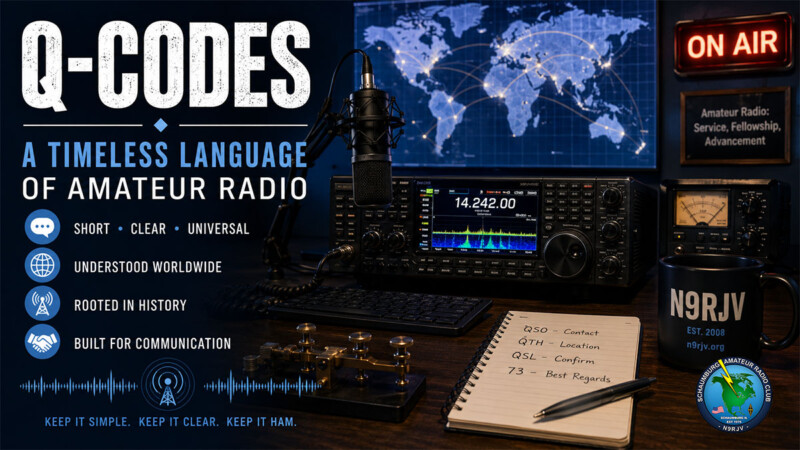
History, operating guide, and complete amateur radio reference
The Q-code is a family of compact operating groups whose members normally contain three letters and begin with Q. It was developed for radiotelegraphy so operators could exchange recurring questions, answers, instructions, and reports with fewer characters and less dependence on a shared spoken language. The legacy reference rebuilt here also notes that the Q initial helps distinguish these groups from ordinary station call signs.[1]
In radiotelegraphy, a question mark changes a Q group into a question. Without the question mark, the same group usually functions as an answer, statement, or instruction. The current ITU maritime recommendation specifies RQ—spoken as “Romeo Quebec”—for the equivalent question form in radiotelephony, although radio amateurs commonly ask the meaning in ordinary speech. Q-codes can be completed with call signs, place names, times, frequencies, numbers, and other data.[2] The 1912 international service regulations already demonstrated the question-mark convention with worked examples.[3]
Although the system arose in the Morse era, Q-codes remain part of amateur CW and voice practice. The ITU’s 2026 amateur-service handbook still describes a two-way contact as a QSO and points readers to Recommendation ITU-R M.1172.[7]
Q-Codes at a Glance
| Form | Typical function | Example |
|---|---|---|
QTH? |
Question in radiotelegraphy | What is your position or location? |
QTH CHICAGO |
Answer or statement | My location is Chicago. |
QSY 7.040 |
Instruction or proposal | Change to 7.040 MHz. |
QSL |
Acknowledgement | I acknowledge receipt; in informal amateur usage, it can also mean a contact confirmation or QSL card. |
ITU Operating Rules That Matter
- A question mark follows the Q group in radiotelegraphy;
RQperforms that role in formal radiotelephony. - The letters
CandNOmay add affirmative and negative senses to certain groups. - Call signs, places, figures, frequencies, times, and other details may complete a meaning.
- Where a group has numbered alternatives, the selected number follows the abbreviation.
- Times are Coordinated Universal Time unless the exchange says otherwise.
- An asterisk in ITU-R M.1172 marks a meaning similar to one in the International Code of Signals.
---
config:
  markdownAutoWrap: true
  flowchart:
    wrappingWidth: 220
    useMaxWidth: true
    nodeSpacing: 40
    rankSpacing: 50
---
flowchart TD
    A["`Receive a
Q group`"]

    B{"`Is it followed by a
question mark or RQ?`"}

    C["`Read it as a request for
information or action`"]

    D["`Read it as an answer,
statement, or instruction`"]

    E{"`Are call signs, numbers,
times, or places attached?`"}

    F["`Apply the added details
in the transmitted order`"]

    G["`Use the group's
basic meaning`"]

    H["`Respond
or act`"]

    A --> B

    B -->|"Yes"| C
    B -->|"No"| D

    C --> E
    D --> E

    E -->|"Yes"| F
    E -->|"No"| G

    F --> H
    G --> H
History of the Q-Codes
Early Development Before International Adoption
Wireless operators in the first decade of the twentieth century worked with slow manual Morse, unstable signals, heavy static, interference, and crews who did not always share a language. A short standardized group could replace a complete operational sentence and reduce opportunities for error. The Q-code system is commonly traced to a British Post Office list used around 1909, although surviving secondary accounts differ in how they count and describe the earliest groups.[9]
London, 1912: An International Operating Language
The International Radiotelegraph Conference met in London from 4 June through 5 July 1912. It revised the convention and service regulations and emphasized intercommunication and safety at sea.[4] The resulting detailed regulations included a multi-page “List of Abbreviations to be used in Radiotelegraph Transmissions,” with Q groups for station identity, distance, bearings, destination, reception quality, interference, atmospheric noise, power, speed, readiness, traffic, and other recurring needs.[3]
The 1912 regulations also established the core grammar that still makes the system easy to learn: add a question mark to ask the question; omit it to give the associated answer or advice. The regulations were published in 1913 and came into force on 1 July 1913.[3]
The Interwar Regulatory Framework
At Washington in 1927, administrations revised the International Radiotelegraph Convention and the general and additional radio regulations, established a table allocating frequencies among services, and created the International Radio Technical Consultative Committee, later known as the CCIR.[5] These broader international mechanisms gave operating signals such as Q-codes a stable regulatory environment in which to evolve across services.
Atlantic City, 1947
The 1947 Atlantic City conferences revised the global radio framework, changed frequency allocations, created the International Frequency Registration Board, and produced new Radio Regulations and Additional Radio Regulations.[6] Q-code assignments were increasingly organized by service, helping explain why amateur operators use only a practical subset while maritime, aeronautical, and other services have additional groups.
Modern ITU Standardization and Amateur Survival
Recommendation ITU-R M.1172, issued in 1995, codifies miscellaneous abbreviations and signals for maritime-mobile radio communication. Its Q-code annex runs from QOA through QUZ, reserving QOA through QQZ for the maritime mobile service and documenting the question, answer, and advice forms used for the later groups.[2]
Amateur radio retained the groups that solve everyday station problems: frequency, readability, interference, static, power, speed, availability, acknowledgement, contact, location, and time. Many became ordinary radio nouns or verbs—operators make a QSO, send a QSL, operate QRP, encounter QRM, or QSY to a clear frequency. ARRL’s historical overview likewise describes the long transition from formal operating signals to informal amateur vocabulary.[8]
---
config:
  markdownAutoWrap: true
  flowchart:
    wrappingWidth: 220
    useMaxWidth: true
    nodeSpacing: 40
    rankSpacing: 50
---
flowchart TD
    A["`About 1909:
early British operating shorthand`"]

    B["`1912:
London conference adopts
international abbreviations`"]

    C["`1 July 1913:
revised service regulations
take effect`"]

    D["`1927:
Washington revises regulations
and creates CCIR`"]

    E["`1947:
Atlantic City revises the
world radio framework`"]

    F["`1995:
ITU-R M.1172 standardizes
maritime Q-code use`"]

    G["`Today:
a practical subset remains active
in amateur CW and voice`"]

    A --> B
    B --> C
    C --> D
    D --> E
    E --> F
    F --> G
| Date | Milestone |
|---|---|
| About 1909 | An early British Post Office operating list is commonly cited as a precursor. |
| 1912 | The London conference incorporates international radiotelegraph abbreviations into revised service regulations. |
| 1 July 1913 | The revised London regulations enter into force. |
| 1927 | The Washington conference revises radio rules and creates the CCIR. |
| 1947 | The Atlantic City conference produces revised radio regulations and a new frequency-management framework. |
| 1995 | ITU-R M.1172 documents modern maritime-mobile abbreviations and signals. |
| Present | Q-codes remain standard operating vocabulary in amateur CW and voice. |
How to Use Q-Codes on the Air
Question and Answer Pairs
A Q-code is most useful when both operators understand its paired forms. For example, QRG? asks for an exact frequency, while QRG 14.060 MHz supplies it. QRV? asks whether the other operator is ready, while QRV states readiness. The surrounding exchange determines whether a bare group is descriptive, advisory, or imperative.
A Typical Amateur Contact
---
config:
  markdownAutoWrap: true
  flowchart:
    wrappingWidth: 220
    useMaxWidth: true
    nodeSpacing: 40
    rankSpacing: 50
---
flowchart TD
    A["`Call or answer
a station`"]

    B["`Exchange
call signs`"]

    C["`Check frequency, readability,
strength, and interference`"]

    D["`Exchange names, locations,
reports, and other information`"]

    E{"`Is a relay or frequency
change needed?`"}

    F["`Use QSP or QSO
relay wording`"]

    G["`Use QSY with the
destination frequency`"]

    H["`Continue
the contact`"]

    I["`Acknowledge important
information with QSL`"]

    J["`Close the QSO
or go QRT`"]

    A --> B
    B --> C
    C --> D
    D --> E

    E -->|"Relay"| F
    E -->|"Change frequency"| G
    E -->|"No"| H

    F --> H
    G --> H
    H --> I
    I --> J
Good Operating Practice
- Use only as many Q-codes as improve clarity; plain language is often better on voice.
- Do not assume an informal amateur meaning is identical to the formal ITU meaning.
- Attach the needed number, time, frequency, place, or call sign rather than forcing the other operator to guess.
- On CW, preserve the question mark when asking; without it, the same group may be read as a statement or command.
- When handling formal traffic, emergency work, maritime communication, or examinations, consult the governing current publication rather than an informal list.
Amateur Radio International Q-Code
Radio amateurs rely on a subset of the larger international system. The exact list emphasized in training or examination material can vary by administration, but the following table preserves every formal amateur entry shown on the legacy page, with newly written wording and the paired question and answer forms.[1]
| Code | Question form | Answer, statement, or instruction |
|---|---|---|
QRA |
What name or call sign identifies your station? | My station is identified as … |
QRB |
Approximately how far is your station from mine? | The distance between our stations is about … nautical miles or kilometres. |
QRG |
What is my exact frequency, or the exact frequency of …? | Your exact frequency, or that of …, is … kHz or MHz. |
QRH |
Is my transmitted frequency varying? | Your frequency is varying. |
QRI |
How would you rate the tone of my transmission? | Your transmitted tone is rated 1 (good), 2 (variable), or 3 (poor). |
QRK |
How intelligible are my signals, or the signals of …? | The intelligibility is … on a scale from 1 (bad) to 5 (excellent). |
QRL |
Are you busy? | I am busy, or I am working …; please do not interfere. |
QRM |
Is my transmission being affected by interference? | Your transmission is being affected by interference. |
QRN |
Are you troubled by atmospheric noise or static? | I am troubled by atmospheric noise or static. |
QRO |
Should I increase transmitter power? | Increase transmitter power. |
QRP |
Should I reduce transmitter power? | Reduce transmitter power. |
QRQ |
Should I send faster? | Send faster, at about … words per minute. |
QRS |
Should I send more slowly? | Send more slowly, at about … words per minute. |
QRT |
Should I stop or suspend operation? | Stop sending; I am suspending operation. |
QRU |
Do you have anything for me? | I have nothing for you. |
QRV |
Are you ready? | I am ready. |
QRX |
Should I wait, or when will you call me again? | Wait; I will call you again at … hours on … kHz or MHz. |
QRZ |
Who is calling me? | You are being called by … on … kHz or MHz. |
QSA |
What is the strength of my signals, or those of …? | Signal strength is … on a scale from 1 (very weak) to 5 (very strong). |
QSB |
Are my signals fading? | Your signals are fading. |
QSD |
Is my keying defective? | Your keying is defective. |
QSK |
Can you hear me between your own signals, and may I break in? | I can hear you between my signals; break in during my transmission. |
QSL |
Can you acknowledge receipt? | I acknowledge receipt. |
QSM |
Should I repeat the last message, or an earlier one? | Repeat the last message, or message number … |
QSN |
Did you hear me, or …, on … kHz or MHz? | I heard you, or …, on … kHz or MHz. |
QSO |
Can you communicate with … directly or through a relay? | I can communicate with … directly, or through relay station … |
QSP |
Will you relay a message to …? | I will relay a message to … |
QSS |
What working frequency will you use? | I will use … kHz or MHz as the working frequency. |
QSU |
Should I send or reply on this frequency, or on … kHz or MHz? | Send or reply on this frequency, or on … kHz or MHz. |
QSV |
Should I transmit a series of V characters on this frequency, or on … kHz or MHz? | Transmit a series of V characters on this frequency, or on … kHz or MHz. |
QSX |
Will you listen to … on … kHz or MHz? | I am listening to … on … kHz or MHz. |
QSY |
Should I change transmission frequency to … kHz or MHz? | Change transmission frequency to … kHz or MHz. |
QSZ |
Should I send every word or group more than once? | Send each word or group twice, or … times. |
QTC |
How many telegrams or messages do you have to send? | I have … messages for you, or for … |
QTH |
What is your position by latitude and longitude, or another location description? | My position or location is … |
QTR |
What is the correct time? | The correct time is … hours. |
Amateur Radio Informal Q-Code
In everyday amateur conversation, many groups have become substitutes for single words or short phrases. These informal meanings are convenient, but they are not always identical to the formal question-and-answer definitions. The table preserves all informal entries shown on the legacy page, including the four-letter extension QRSS.[1]
| Code | Typical shorthand | Operating note |
|---|---|---|
QRA |
Name or station identity | Common shorthand for a name, call sign, or station identity. |
QRB |
Distance | Approximate separation between stations. |
QRG |
Frequency | Often used to mean the operating frequency itself. |
QRK |
Readability or intelligibility | A report of how understandable a signal is. |
QRL |
Busy | The frequency or operator is occupied. |
QRM |
Interference | Usually interference from another transmission or human-made source. |
QRN |
Noise or static | Usually atmospheric or natural radio noise. |
QRO |
High power | Used as a noun or adjective for increased transmitter power. |
QRP |
Low power | Also names the low-power operating specialty. |
QRQ |
Fast CW | Higher Morse sending speed. |
QRS |
Slow CW | Reduced Morse sending speed. |
QRSS |
Very slow CW | A four-letter amateur extension, not one of the ITU three-letter Q-code groups. |
QRT |
Close down or stop transmitting | Often used as a verb: the station is going QRT. |
QRV |
Ready | Ready to receive, transmit, or begin an activity. |
QRX |
Stand by | Wait briefly or listen for a later call. |
QRZ? |
Who is calling me? | The question form is commonly heard on voice as well as CW. |
QSB |
Fading | Variation of received signal level over time. |
QSD |
Defective keying | Long-standing amateur usage; the current maritime recommendation uses broader wording. |
QSK |
Break-in operation | The receiving station can hear between its transmitted elements or signals. |
QSL |
Acknowledgement or contact-confirmation card | May refer to receipt confirmation, the act of confirming, or a paper/electronic QSL. |
QSO |
Radio contact | Widely used as a noun for a two-way amateur contact. |
QSY |
Change frequency | Often used as a verb: move to another frequency. |
QTC |
Message or traffic | A radiogram, telegram, or piece of traffic. |
QTH |
Location | A station location, address, grid locator, or operating site. |
QTR |
Time | The current or correct time. |
Reporting Scales and Graphs
Common Numerical Scales
| Code | What it reports | Scale | Maximum |
|---|---|---|---|
QRI |
Transmitted tone | 1 good; 2 variable; 3 poor | 3 |
QRK |
Intelligibility | 1 bad through 5 excellent | 5 |
QSA |
Signal strength | 1 scarcely perceptible/very weak through 5 very good/very strong | 5 |
QRM |
Interference severity in ITU-R M.1172 | 1 nil through 5 extreme | 5 |
QRN |
Static severity in ITU-R M.1172 | 1 nil through 5 extreme | 5 |
xychart-beta
    title "Maximum value of common Q-code reporting scales"
    x-axis ["QRI tone", "QRK intelligibility", "QSA strength", "QRM interference", "QRN static"]
    y-axis "Maximum scale value" 0 --> 5
    bar [3, 5, 5, 5, 5]
Distribution of the Legacy Full-List Rows
The rebuilt QRA–QUZ table contains 103 displayed rows: 26 QR rows, 25 QS rows, 27 QT rows, and 25 QU rows. The QT count is 27 because the source page displays QTI twice with two different wordings; both rows are retained and explained in the verification notes.
pie showData
    title Legacy QRA–QUZ reference rows by prefix
    "QR" : 26
    "QS" : 25
    "QT, including duplicated QTI" : 27
    "QU" : 25
| Prefix | Displayed rows | Note |
|---|---|---|
QR |
26 | QRA through QRZ |
QS |
25 | QSA through QSZ, with no QST row on the legacy page |
QT |
27 | QTA through QTZ, counting the duplicated QTI display |
QU |
25 | QUA through QUZ, with no QUV row on the legacy page |
| Total | 103 | Every displayed source-page row is retained below. |
Full International Q-Code Reference: QRA–QUZ
The following is the broader list carried by the legacy page. Most of these groups relate to maritime traffic, direction finding, rescue, weather, navigation, or formal message handling and are rarely needed in ordinary amateur contacts. The source page shows only the question or statement side for this larger table; that structure is retained here, with the wording independently rewritten.[1]
This is not the whole universe of Q groups. Other ranges have been assigned or used in maritime and aeronautical services. For current formal maritime meanings and their complete answer/advice forms, Recommendation ITU-R M.1172 is the controlling reference used for verification here.[2]
| Code | Question, instruction, or statement |
|---|---|
QRA |
What is the name of your station? |
QRB |
Approximately how far are you from my station? |
QRC |
Which enterprise or administration settles the charge accounts for your station? |
QRD |
Where are you bound, and where have you come from? |
QRE |
What is your estimated arrival time at, or over, the stated place? |
QRF |
Are you returning to the stated place? |
QRG |
What is my exact frequency, or the exact frequency of the named station? |
QRH |
Is my frequency varying? |
QRI |
How would you describe the tone of my transmission? |
QRJ |
How many radiotelephone calls do you have to book? |
QRK |
How intelligible are my signals, or those of the named station? |
QRL |
Are you busy? |
QRM |
Is your reception or transmission being interfered with? |
QRN |
Are you troubled by static? |
QRO |
Should I increase transmitter power? |
QRP |
Should I decrease transmitter power? |
QRQ |
Should I send faster? |
QRR |
Are you ready for automatic operation? |
QRS |
Should I send more slowly? |
QRT |
Should I stop sending? |
QRU |
Do you have anything for me? |
QRV |
Are you ready? |
QRW |
Should I tell the named station that you are calling on the stated frequency? |
QRX |
When will you call me again? |
QRY |
What is my turn in the communication sequence? |
QRZ |
Who is calling me? |
QSA |
What is the strength of my signals, or those of the named station? |
QSB |
Are my signals fading? |
QSC |
Are you a cargo vessel? |
QSD |
Is my keying defective? |
QSE |
What is the estimated drift of the survival craft? |
QSF |
Have you completed a rescue? |
QSG |
Should I send the stated number of telegrams at one time? |
QSH |
Can you home using your direction-finding equipment? |
QSI |
I have been unable to break in on your transmission. |
QSJ |
What charge must be collected to the stated destination, including your internal charge? |
QSK |
Can you hear me between your signals, and may I break in? |
QSL |
Can you acknowledge receipt? |
QSM |
Should I repeat the last telegram, or a specified earlier telegram? |
QSN |
Did you hear me, or the named station, on the stated frequency? |
QSO |
Can you communicate with the named station directly or by relay? |
QSP |
Will you relay to the named station without charge? |
QSQ |
Do you have a doctor aboard, or is the named person aboard? |
QSR |
Should I repeat the call on the calling frequency? |
QSS |
Which working frequency will you use? |
QSU |
Should I send or reply on this frequency, or on the stated frequency? |
QSV |
Should I send a series of V characters on this frequency, or on the stated frequency? |
QSW |
Will you transmit on this frequency, or on the stated frequency? |
QSX |
Will you listen for the named station on the stated frequency? |
QSY |
Should I change to another transmission frequency? |
QSZ |
Should I transmit each word or group more than once? |
QTA |
Should I cancel the stated telegram or message? |
QTB |
Do you agree with my count of the words? |
QTC |
How many telegrams or messages do you have to send? |
QTD |
What has the rescue vessel or rescue aircraft recovered? |
QTE |
What is my true bearing from you? |
QTF |
Will you provide my position from the bearings taken by the direction-finding stations you control? |
QTG |
Will you send two ten-second dashes, or a carrier, followed by your call sign, repeated as specified, on the stated frequency? |
QTH |
What is your position in latitude and longitude? |
QTI |
What is your true track? |
QTI |
What is your true course? |
QTJ |
What is your speed? |
QTK |
What is your aircraft’s speed relative to the Earth’s surface? |
QTL |
What is your true heading? |
QTM |
What is your magnetic heading? |
QTN |
At what time did you leave the stated place? |
QTO |
Have you left the dock or port? |
QTP |
Are you about to enter the dock or port? |
QTQ |
Can you communicate with my station by the International Code of Signals? |
QTR |
What is the correct time? |
QTS |
Will you send your call sign for tuning or frequency-measurement purposes now, or at the stated time and frequency? |
QTT |
The identification signal that follows is superimposed on another transmission. |
QTU |
During which hours is your station open? |
QTV |
Should I keep watch for you on the stated frequency during the stated period? |
QTW |
What is the condition of the survivors? |
QTX |
Will you keep your station open for further communication until further notice or the stated time? |
QTY |
Are you proceeding to the incident position, and when do you expect to arrive? |
QTZ |
Are you continuing the search? |
QUA |
Do you have news of the named station or person? |
QUB |
Can you report, in order, surface-wind direction and speed, visibility, present weather, and cloud amount, type, and base height at the stated place? |
QUC |
What is the number or identifier of the last message you received from me or the named station? |
QUD |
Have you received the urgency signal sent by the named mobile station? |
QUE |
Can you use radiotelephony in the stated language, with an interpreter if needed, and on which frequencies? |
QUF |
Have you received the distress signal sent by the named station? |
QUG |
Will you be forced to alight or land? |
QUH |
Will you provide the current barometric pressure reduced to sea level? |
QUI |
Are your navigation lights operating? |
QUJ |
Will you indicate the true track required to reach you or the named position? |
QUK |
What sea condition did you observe at the stated place? |
QUL |
What swell did you observe at the stated place? |
QUM |
May normal working resume? |
QUN |
Will vessels nearby state their position, course, and speed? |
QUO |
Should I search for the stated aircraft, vessel, or survival craft? |
QUP |
Will you show your position with a searchlight, black smoke, or pyrotechnic lights? |
QUQ |
Should I direct my searchlight almost vertically at a cloud and, when your aircraft is seen, deflect the beam upwind and onto the water? |
QUR |
Have the survivors received survival equipment, been picked up by a rescue vessel, or been reached by a ground rescue party? |
QUS |
Have you seen survivors or wreckage? |
QUT |
Is the incident position marked? |
QUU |
Should I home a vessel or aircraft to my position? |
QUW |
Are you within the designated search area? |
QUX |
Are any navigation warnings or gale warnings in force? |
QUY |
Is the survival craft’s position marked? |
QUZ |
May restricted working resume? |
Verification and Editorial Notes
Preserved Legacy Differences
| Item | Legacy-page wording retained above | Verified clarification |
|---|---|---|
QSC |
Asks whether the station is a cargo vessel. | The 1995 ITU-R M.1172 table asks whether it is a low-traffic ship station. The legacy wording is preserved so no source-page entry disappears. |
QSD |
Asks whether keying is defective. | That wording is established in amateur usage. ITU-R M.1172 uses the broader maritime wording “signals mutilated.” |
QTI |
Appears twice: once for true track and once for true course. | Current ITU-R M.1172 assigns QTI to true course. The request for the true track needed to reach a station is represented by QUJ. Both legacy rows remain visible above. |
QST |
No row appears. | No QST row appears in the legacy QRA–QUZ list or the Q-code table in ITU-R M.1172, so one has not been invented for this rebuild. |
QUV |
No row appears. | No QUV row appears in the legacy QRA–QUZ list or the Q-code table in ITU-R M.1172, so one has not been invented for this rebuild. |
QRSS |
Appears in the informal amateur table. | It is deliberately retained as common amateur shorthand for extremely slow CW, but it is four letters and is not one of the ITU three-letter groups. |
References
- The international Q-code / Amateur radio informal Q-code. Giangrandi.org. Legacy page created October 1999 and last updated October 2013. Accessed 10 July 2026. https://www.giangrandi.org/electronics/radio/qcode.shtml
- Recommendation ITU-R M.1172: Miscellaneous abbreviations and signals to be used for radiocommunications in the maritime mobile service. International Telecommunication Union. 1995. Accessed 10 July 2026. https://www.itu.int/rec/R-REC-M.1172/en
- Detailed Service Regulations appended to the International Radiotelegraph Convention (London, 1912). His Majesty’s Stationery Office; digital scan by the ITU Library and Archives Service. Published 1913. Accessed 10 July 2026. https://search.itu.int/history/HistoryDigitalCollectionDocLibrary/1.3.48.en.100.pdf
- International Radiotelegraph Conference (London, 1912). International Telecommunication Union, History of ITU Portal. Conference held 4 June–5 July 1912. Accessed 10 July 2026. https://www.itu.int/en/history/Pages/RadioConferences.aspx?conf=4.37
- International Radiotelegraph Conference (Washington, 1927). International Telecommunication Union, History of ITU Portal. Conference held 4 October–25 November 1927. Accessed 10 July 2026. https://www.itu.int/en/history/Pages/RadioConferences.aspx?conf=4.39
- International Radio Conference (Atlantic City, 1947). International Telecommunication Union, History of ITU Portal. Conference held 16 May–2 October 1947. Accessed 10 July 2026. https://www.itu.int/en/history/Pages/RadioConferences.aspx?conf=4.62
- Handbook on Amateur and amateur-satellite services. International Telecommunication Union. 2026 edition. Accessed 10 July 2026. https://www.itu.int/dms_pub/itu-r/opb/hdb/R-HDB-52-2026-PDF-E.pdf
- Ham Radio History. American Radio Relay League. Historical overview of amateur operating language and Q-signals. Accessed 10 July 2026. https://www.arrl.org/ham-radio-history
- Q-codes. Crypto Museum. Historical overview; used cautiously for the commonly cited pre-1912 origin. Accessed 10 July 2026. https://www.cryptomuseum.com/ref/qcodes/