
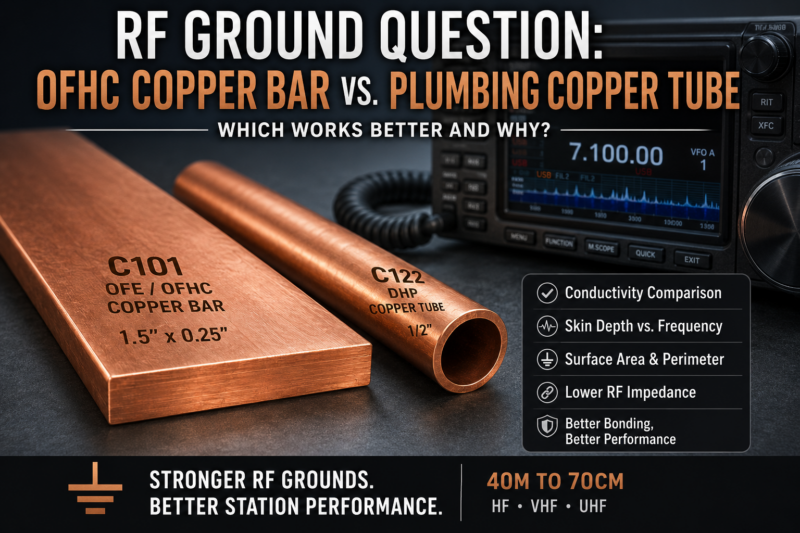
40m – 70cm Ham Station RF
Executive summary
For the two candidates you specified, the 1.5 × 0.25 inch copper bar is the better RF ground conductor for a ham station bond or entry-panel ground path from 7 MHz through 430 MHz. Under a conservative model that treats your H02 bar as 100% IACS copper and treats “standard plumbing copper” as the common C12200 phosphorus-deoxidized plumbing tube at 85% IACS, the bar has about 1.9× lower calculated RF AC resistance per unit length than a representative 1/2-inch nominal plumbing tube across the entire 40 m–70 cm range. Its DC resistance is also far lower because it contains much more copper cross-section. The bar’s advantage comes mostly from geometry and alloy choice: it is wide and flat, so it presents more usable surface for RF current, and it is not penalized by the phosphorus used in plumbing copper.[1][4][17]
The subtle but important nuance is that the real electrical jump is not from C110 to C101. Official copper-alloy sources show that C10100 OFE is indeed purer than C11000 ETP, but the conductivity difference is small in practice: C10100 is specified at 101% IACS in the annealed condition, while C11000 has a minimum annealed conductivity of 100% IACS and a typical physical-property listing of about 101% IACS. By contrast, C12200 plumbing copper is about 85% IACS, so going from electrical copper to plumbing copper is the much bigger electrical downgrade. In other words, your flat bar beats plumbing tube mainly because it is flat and because plumbing alloy is worse, not because OFE is magically far better than ordinary electrical-grade copper.[1][3][4][5]
There is also a practical RF-grounding caveat: at HF/VHF/UHF, the few tens of milliohms of conductor resistance are usually less important than path impedance from length, bends, and routing. Motorola R56 explicitly says grounding conductors should be short, straight, smooth, and with as few bends as possible, and it explicitly prefers solid copper strap because it has lower inductance than large round wire conductors. So the bar is the better choice, but the biggest improvement still comes from topology: single-point bonding, short runs, gentle bends, and good connections.[15]
My bottom-line recommendation is therefore:
- If you are choosing between these two exact candidates for station RF grounding, use the 1.5 × 0.25 inch copper bar.
- If you are buying new material and cost matters, a flat C110 copper strap or bar is usually the best value compromise; true OFE/C101 is electrically excellent but usually unnecessary for a ham-station ground bond.
Scope and assumptions
This report treats “RF ground” as the station bonding/ground conductor used to connect radio equipment, an entry panel, or a house/external ground bar together, rather than as an antenna radial field or a tuned RF counterpoise. That distinction matters because for station bonding, conductor geometry and routing often control performance more than raw material purity. Motorola R56’s guidance for communication sites is a good fit for that use case: it calls for conductors that are short, straight, smooth, and it specifically prefers copper strap where reduced impedance is desired.[15]
Because the plumbing conductor was not fully specified, I used a representative and realistic assumption: 1/2-inch nominal copper water tube per ASTM B88, UNS C12200, with the standard plumbing outside diameter of 0.625 inch. For DC calculations, I show both Type L and Type M wall thicknesses from the Copper Tube Handbook. For RF AC calculations, Type L and Type M come out essentially the same because the first-order RF resistance depends mainly on outside diameter, not wall thickness, when current is confined to the outside skin. If your “approx. 1/2 inch diameter” copper is actually a solid 0.500 inch round rod instead of plumbing tube, it performs a bit worse at RF than the 0.625 inch OD tube assumption; that would only strengthen the case for the bar.[10][11][12]
All calculations below are at 20 °C, using the classical good-conductor skin-effect approximation with μr ≈ 1 for copper. For the bar, I used 100% IACS as the calculation basis because your exact commercial 101-H02 ASTM B187 product listing states 100% IACS; official C10100 datasheets list 101% IACS in the soft condition, and CDA notes that cold work can pull conductivity down by about 1 to 5 percentage points from annealed values. Using 101% instead of 100% would change the bar’s calculated RF resistance by only about 0.5%, which does not affect the recommendation.[1][6][17]
For the AC model, I used the classical skin-depth and surface-resistance relations for metals, then applied them to each conductor’s effective outside perimeter. NIST technical notes describe the standard metal skin-depth and surface-resistance relationships and note that surface resistance rises with frequency while skin depth falls. I ignored proximity effect and nearby-metal crowding in the base tables, so the tabulated RF resistances are best treated as first-order, lower-bound conductor values. In practice, mounting a conductor near other metal can increase its effective impedance.[13][14]
Material identity, standards, and conductivity
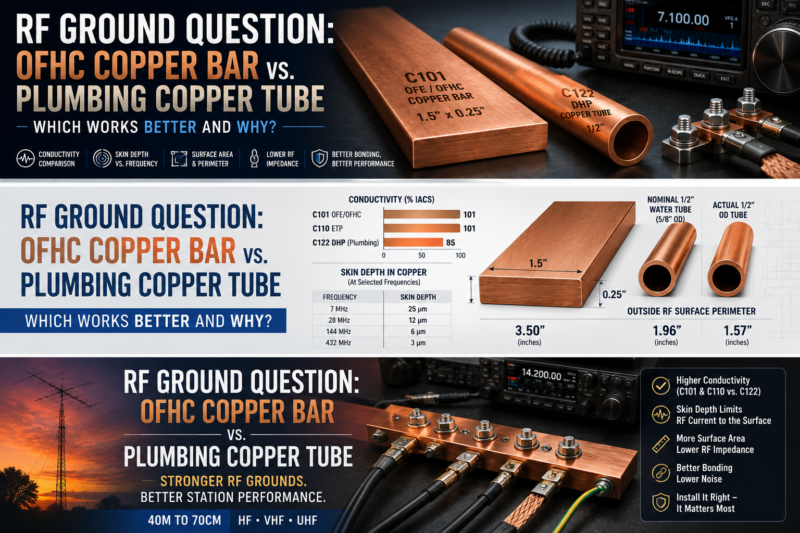
Your bar description — 99.99% OFE/OFHC copper, ASTM B187, H02 temper — lines up most closely with UNS C10100 OFE, not generic C10200 OF copper. Official alloy data show C10100 as 99.99% minimum Cu with 101% IACS conductivity in the soft condition; C10200 is the lower-purity oxygen-free grade at 99.95% minimum Cu and 100% IACS in the soft condition. Copper.org also notes that “OFHC” is historical trade language; formally, the common oxygen-free grades are OFE/C10100 and OF/C10200. So if the stock is truly 99.99%, that is a C10100/OFE-type product rather than ordinary C10200.[1][2][8]
Official sources also show why the C101 vs C110 discussion is often oversimplified. Copper.org’s C11000 alloy page gives 99.90% minimum Cu and says the alloy has a minimum annealed conductivity of 100% IACS; the same page’s physical-properties section lists 101% IACS as an actual property value. That means it is true that C10100 is purer than C11000, but it is not true that C10100 enjoys a dramatic conductivity lead over C11000 in ordinary room-temperature service. The difference is modest, and cold work can erase part of it. By contrast, plumbing alloy C12200 is listed at 85% IACS, which is a genuinely large step down.[3][4][5]
The plumbing side is much less ambiguous. Mueller Streamline, a primary U.S. tube manufacturer, states that its plumbing copper tube is made from UNS C12200 and manufactured to ASTM B88 for Type K, L, and M water tube. Copper.org’s C12200 alloy page lists 85% IACS, and the CDA engineering guide explicitly remarks that phosphorus-deoxidized copper can have about 99.9% copper content yet only 85% IACS, because phosphorus strongly depresses conductivity. That is the key reason ordinary plumbing copper is a poorer electrical conductor than electrical grades.[4][5][11]
The standards picture is therefore straightforward. ASTM B187/B187M is the governing specification family for copper bus bar, rod, and shapes for electrical applications; ASTM’s own scope summary says it covers copper conductor bars, rods, and shapes for electrical bus and general applications. Your specific commercial 101-H02 bar is sold as ASTM B187, and CDA’s ASTM B601 temper examples identify H02 as 1/2 hard. Typical plumbing copper is instead bought to ASTM B88 as C12200 water tube.[6][9][10][17]
The conductivity and alloy comparison that matters for your decision is summarized below. The values in the right-hand columns are the ones that matter most for electrical grounding work at room temperature.
| Alloy | Common name | Cu purity / key chemistry | Conductivity at 20 °C | Resistivity basis |
|---|---|---|---|---|
| C10100 | OFE | 99.99% min Cu, O max 0.0005% | 101% IACS in soft condition | about 1.707 µΩ·cm |
| C10200 | OF / OFHC-type | 99.95% min Cu, O max 0.001% | 100% IACS in soft condition | 1.7241 µΩ·cm |
| C11000 | ETP electrical copper | 99.90% min Cu+Ag, oxygen-bearing | minimum 100% IACS annealed; typical page value 101% IACS | 1.7241 µΩ·cm nominal IACS basis |
| C12200 | DHP plumbing copper | phosphorus-deoxidized | 85% IACS | about 2.028 µΩ·cm |
The temperature/temper story is also important but secondary. CDA’s copper property guide states that cold-worked tempers may run 1 to 5 percentage points below the annealed conductivity value, and gives annealed high-conductivity copper at 100–101.5% IACS versus 97% IACS for fully cold-worked material. The same guide gives the temperature coefficient of resistance for 100% IACS annealed copper as 0.00393/°C at 20 °C, so a copper ground conductor at 50 °C will have about 11.8% higher resistance than the same conductor at 20 °C. In practice, that means alloy choice matters more than H02 vs annealed, and routing matters more than either for RF grounding.[6][7]
RF calculations and comparison
For a good conductor at RF, current is confined to a very thin layer near the surface. Using the classical skin-effect approximation, skin depth is
δ = √(ρ / (π f μ)),
and surface resistance is
Rs = ρ / δ = √(π f μ ρ).
For an isolated long conductor whose outside dimensions are all much larger than δ, the first-order AC resistance per unit length is well approximated by R′ ≈ Rs / Peff, where Peff is the conductor perimeter that actually carries current. For the wide bar, I used the full outside perimeter 2(w+t); for the plumbing tube, I used the outer circumference πD. This is the correct comparison for a practical station bond where current is on the external conductor surface.[13][14]
The geometry is where the bar starts to pull ahead. The 1.5 × 0.25 in bar has a total outside perimeter of 3.5 in, while a representative 1/2-in nominal plumbing tube with 0.625 in OD has an outside circumference of only 1.963 in. So even if both were the same conductivity, the bar would already offer about 78% more RF-carrying perimeter. After you include alloy conductivity — 100% IACS for the H02 C101 bar basis versus 85% IACS for C12200 tube — the plumbing tube’s calculated RF resistance comes out about 1.93× higher than the bar’s across the whole 7–430 MHz span.[4][12][17]
The DC picture is even more one-sided. The bar’s metal cross-sectional area is 0.375 in². A representative 1/2-in Type L tube has only about 0.0735 in² of copper metal, and Type M only about 0.0525 in². That gives the bar a DC resistance of about 0.071 mΩ/m, compared with 0.428 mΩ/m for Type L and 0.599 mΩ/m for Type M. DC resistance matters most for fault/equalization currents and lightning-energy distribution; RF resistance matters more for RF current on the bond itself. In both regimes, the bar wins.[12]
The table below gives the geometry and DC resistance basis. The RF tables that follow use the Type L/M outside diameter of 0.625 in for the plumbing conductor, because that is what controls first-order RF resistance. Sources for dimensions and conductivity are cited in the note beneath the table; the arithmetic itself is mine.
| Candidate | Assumed form | Key dimensions | Effective outside perimeter | Copper metal area | DC resistance |
|---|---|---|---|---|---|
| OFE bar | Solid rectangular bar | 1.5 in × 0.25 in | 3.500 in | 0.3750 in² | 0.0713 mΩ/m |
| Plumbing copper Type L | Round tube | 0.625 in OD, 0.545 in ID | 1.963 in | 0.0735 in² | 0.4277 mΩ/m |
| Plumbing copper Type M | Round tube | 0.625 in OD, 0.569 in ID | 1.963 in | 0.0525 in² | 0.5987 mΩ/m |
| Round 0.500 in solid reference | Solid round | 0.500 in OD | 1.571 in | 0.1963 in² | 0.1601 mΩ/m |
Now the RF results. The copper skin depth is only a few tens of micrometers at HF and only a few micrometers by 430 MHz, so both conductors are very much in the skin-effect regime. At 7 MHz, the calculated skin depth is about 25.0 µm for the bar’s 100% IACS copper basis and 27.1 µm for C12200; by 430 MHz it falls to about 3.19 µm and 3.46 µm, respectively. These depths are tiny compared with either conductor’s macroscopic dimensions, which is why outside perimeter is the controlling geometric term.
| Frequency | Skin depth in bar copper | Skin depth in plumbing copper | AC resistance of bar | AC resistance of plumbing tube | Plumbing/bar ratio |
|---|---|---|---|---|---|
| 7 MHz | 24.98 µm | 27.09 µm | 7.764 mΩ/m | 15.012 mΩ/m | 1.93× |
| 14 MHz | 17.66 µm | 19.16 µm | 10.981 mΩ/m | 21.230 mΩ/m | 1.93× |
| 28 MHz | 12.49 µm | 13.55 µm | 15.529 mΩ/m | 30.024 mΩ/m | 1.93× |
| 50 MHz | 9.35 µm | 10.14 µm | 20.751 mΩ/m | 40.122 mΩ/m | 1.93× |
| 144 MHz | 5.51 µm | 5.97 µm | 35.216 mΩ/m | 68.089 mΩ/m | 1.93× |
| 430 MHz | 3.19 µm | 3.46 µm | 60.855 mΩ/m | 117.660 mΩ/m | 1.93× |
A practical way to read that table is by multiplying by your actual run length. For a 10-foot bond run, the bar’s conductor resistance is about 23.7 mΩ at 7 MHz and 0.185 Ω at 430 MHz; the plumbing tube would be about 45.8 mΩ at 7 MHz and 0.359 Ω at 430 MHz. Those are not huge absolute numbers, which is why it is so important not to over-focus on copper purity alone. The routing and inductive behavior of the bond usually matter more, and that is exactly why wide, flat conductors are preferred in communication-site grounding practice.[15]
One subtle caveat is worth stating explicitly. The bar’s RF-resistance advantage assumes it is installed so its outside surfaces are actually participating in the current flow. If you bolt the bar tightly, face-to-face, against a large conductive sheet or wall plate, one broad face may contribute less to current carrying than in the isolated-conductor model, so the pure “surface resistance” advantage shrinks. Even then, the bar generally remains preferable because it still gives a better low-inductance path and better bonding geometry. That is an inference from the field distribution and the installation geometry, not a direct catalog specification.
Mechanical and installation factors
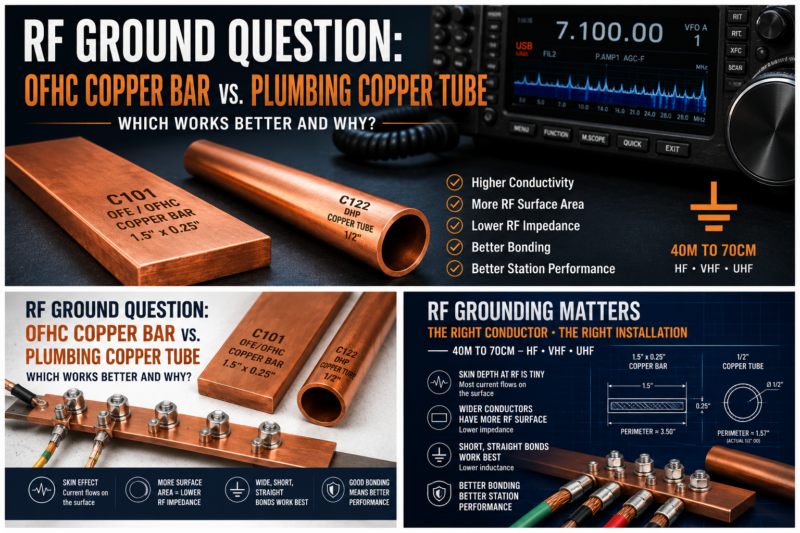
Mechanically, the copper bar is better suited to a ground bus / station bond role. A rigid flat bar is easy to drill, easy to bolt with two-hole lugs, easy to standoff from a wall or entry panel, and easy to use as a real bus bar that multiple chassis and surge protectors can land on. R56 repeatedly shows this style of layout: an external ground bus bar at the cable entry point, bonded by solid copper strap to the grounding electrode system, with a corresponding interior master bus bar. That is much harder to do cleanly with a piece of round plumbing tube unless you start improvising pipe clamps, flattened ends, or custom saddles.[15]
---
config:
  markdownAutoWrap: true
  flowchart:
    wrappingWidth: 220
    useMaxWidth: true
    nodeSpacing: 40
    rankSpacing: 50
---
flowchart TD
    A["`Antenna
feedlines`"]

    B["`Outside-entry
ground bar`"]

    C["`Coax surge protectors
and cable bonds`"]

    D["`Short, wide copper
strap or bar`"]

    E["`Ground ring
or rods`"]

    F["`Through-wall
bond`"]

    G["`Inside master
ground bar`"]

    H["`Transceiver`"]

    I["`Tuner, amplifier,
and power supply`"]

    A --> B
    B --> C
    C --> D
    D --> E

    B --> F
    F --> G

    G --> H
    G --> I
Show code
---
config:
  markdownAutoWrap: true
  flowchart:
    wrappingWidth: 220
    useMaxWidth: true
    nodeSpacing: 40
    rankSpacing: 50
---
flowchart TD
    A["`Antenna
feedlines`"]

    B["`Outside-entry
ground bar`"]

    C["`Coax surge protectors
and cable bonds`"]

    D["`Short, wide copper
strap or bar`"]

    E["`Ground ring
or rods`"]

    F["`Through-wall
bond`"]

    G["`Inside master
ground bar`"]

    H["`Transceiver`"]

    I["`Tuner, amplifier,
and power supply`"]

    A --> B
    B --> C
    C --> D
    D --> E

    B --> F
    F --> G

    G --> H
    G --> I
That topology is not just neat; it matches communication-site practice. R56 says the external ground bar should be at the cable-entry point, should connect directly to the grounding electrode system, and may be connected with solid copper strap because even relatively small strap has significantly less inductance than large wire conductors. It also says the RF transmission-line entry point and ground bar should be installed as low to the ground as practical.[15]
On corrosion and surface condition, both candidate materials are fundamentally good copper alloys with excellent corrosion resistance in ordinary indoor/outdoor service, and C12200’s plumbing heritage is obviously built around that. Aurubis lists excellent corrosion resistance for oxygen-free coppers, and Copper.org lists corrosion resistance among the characteristic reasons C11000 and C12200 are widely used. The bigger real-world hazard is not the bulk alloy but joint quality and dissimilar-metal interfaces. R56 requires removal of paint, enamel, lacquer, and other nonconductive coatings at bonding surfaces, and it warns to use correct methods where dissimilar metals are involved.[3][4][15][16]
On joining methods, the broad engineering lesson is simple: grounding joints should be mechanical/compression/exothermic, not casual solder-only assemblies. R56 prefers exothermic welds, listed irreversible compression connectors, and listed compression two-hole lugs for grounding and bus connections. That strongly favors the flat bar in practice because it naturally accepts bolted lugs and bus-bar hardware. Plumbing copper, by contrast, is optimized for soldered, brazed, or press plumbing joints; Copper.org rates C12200 soldering and brazing as excellent, which is great for plumbing, but it does not make round tube the preferable ham-shack ground bus material.[4][15]
On flexibility, the story splits by temper. Straight stick plumbing tube is often sold in hard temper, while soft Type L coil is sold precisely because it is flexible and easy to snake through a building. That is useful in plumbing but not ideal for RF bonding, because extra curves and bends raise impedance; R56 explicitly warns against sharp bends and says grounding conductors should be run short, straight, and smoothly. Your H02 bar is stiffer than soft copper, which is actually an advantage for maintaining a disciplined routing geometry.[15]
Finally, on surface finish, NIST notes that copper surface roughness has relatively small effect at low frequency and becomes noticeably worse above about 1 GHz. Since your highest band here is 430 MHz, ordinary mill finish or light tarnish on the conductor body is usually not the main issue. The important surface-related problem at amateur frequencies is usually contact resistance at joints, not the conductor’s broad-side finish. Clean, bright metal and high-pressure bolted/compression joints matter more than polishing the entire conductor.[14]
Cost and availability tradeoffs
This is the one category where plumbing copper wins decisively. Current retail/distributor pages show that 1/4 × 1-1/2 in C101 oxygen-free H02 bar is a specialty metal product sold in cut lengths, with a representative price of $35 for 1 ft and $382.54 for 12 ft from an OnlineMetals/Southern Copper listing. By contrast, commodity plumbing copper is stocked at home centers: a representative 1/2 in × 10 ft Type L pipe was about $40.71 or $4.07/ft, a 1/2 in × 10 ft soft Type L coil about $39.62 or $3.96/ft, and Type M around $29.96 or $3.00/ft. So on a small-buy basis, the OFE bar is roughly 8× to 12× more expensive per foot than plumbing copper.[17][18][19]
Availability follows the same pattern. Plumbing copper is a commodity: you can often buy it the same day at a plumbing or home-improvement store. The OFE bar is a specialty electrical/metals item: it is available, but usually by mail order or metals distributor rather than from a local shelf. For many ham projects, that availability difference matters more than the raw metal cost.
There is also an important “best value” observation. If your real goal is simply the best practical station grounding conductor, flat electrical-grade copper is the sweet spot. A representative 1/4 × 1-1/2 in C110-H02 bar is also stocked to ASTM B187, but with electrical conductivity listed at 100% IACS and small-quantity pricing of about $47.33 for 1 ft and $343.12 for 12 ft in one current listing. Official copper-alloy data show that C110’s electrical performance is extremely close to C101 in room-temperature service. So if you want the geometry advantage of a bar/strap without paying a premium for oxygen-free copper, C110 flat copper is usually the logical choice.[3][20]
Recommendation and practical installation tips
For the specific comparison you asked for, the recommendation is clear: the 1.5 × 0.25 inch copper bar will work better than standard 1/2-inch-class plumbing copper as an RF ground conductor for a 40 m through 70 cm ham station. It has lower DC resistance, roughly half the calculated RF AC resistance of representative plumbing tube, lower-inductance geometry in actual grounding practice, and far better mechanical suitability as a real bus or bond conductor.
The most important caveat is that the bar’s biggest advantage is not that it is OFE. If you replaced the bar with a flat C110 electrical copper bar or strap of the same size, you would keep almost all of the practical grounding benefit, because the difference between C101 and C110 is small, while the difference between flat bar and plumbing C12200 tube is large. So if you already own the OFE bar, use it. If you are buying from scratch, flat copper bar or strap is the right form factor, and C110 is usually the better value buy unless you have a special reason to insist on oxygen-free stock.
If you only have plumbing copper on hand, it is still perfectly possible to make an acceptable station bond with it — especially for a very short run — but it becomes the second-best option as the run gets longer, the bands get higher, and the routing gets bendier. The penalty is not that it will “fail” as a ground conductor; it is that its alloy and geometry are both less favorable, so it gives you less performance margin.
Practical installation tips follow directly from the standards and the calculations:
- Use a single-point ground / entry bar arrangement, with the feedline entry bonded immediately to an external ground bar and then to the grounding-electrode system.
- Keep the conductor as short, straight, and smooth as possible. Avoid loops, sharp 90° kinks, and decorative routing. R56 calls for the fewest bends possible and gives an 8-inch minimum bend radius guidance.
- Prefer a wide flat bar or strap over round conductors for the main bond path. R56 specifically says solid copper strap gives lower inductive impedance than large wire conductors.
- Use bolted compression lugs, irreversible compression connectors, or exothermic welds for the grounding path. Do not rely on casual solder-only joints for the primary bond.
- Clean joint surfaces to bright metal. Remove paint, enamel, lacquer, and other nonconductive coatings before bonding.
- If copper meets galvanized steel, aluminum, or other dissimilar metals, use proper bimetallic hardware/practice and protect the finished joint from corrosion.
- If the bar is mounted near other metal, consider standoffs so the conductor remains a real strap/bar rather than becoming a face-clamped plate with reduced useful surface. This is an engineering best practice inferred from the current-distribution model.
Open questions and limitations
The main open-ended element in your prompt is the plumbing conductor itself. “Standard plumbing copper” could mean Type L or Type M, hard straight pipe or soft coil, and possibly even a scrap round rod rather than actual water tube. I treated the most likely case — 1/2-inch nominal ASTM B88 C12200 tube with 0.625 inch OD — and showed why the conclusion is robust even if your exact specimen varies. If your actual round copper is larger in OD than that, its RF result improves somewhat; if it is smaller, it gets worse.
The RF resistance values are also first-order conductor-only calculations. They deliberately do not include proximity effect, nearby metal surfaces, or the complete loop/return inductance of your station grounding network. In practice, those topology issues often dominate, which is why the installation guidance in the recommendation section is every bit as important as the material choice itself.
References
- C10100 Alloy. Copper Development Association / Copper.org. Accessed June 14, 2026. https://alloys.copper.org/alloy/C10100.
- C10200 Alloy. Copper Development Association / Copper.org. Accessed June 14, 2026. https://alloys.copper.org/alloy/C10200.
- C11000 Alloy. Copper Development Association / Copper.org. Accessed June 14, 2026. https://alloys.copper.org/alloy/C11000.
- C12200 Alloy. Copper Development Association / Copper.org. Accessed June 14, 2026. https://alloys.copper.org/alloy/C12200.
- Industrial: Design Guide — Conductivity of Alloy Classes. Copper Development Association / Copper.org. Accessed June 14, 2026. https://copper.org/applications/industrial/DesignGuide/selection/conductalloy02.php.
- A Guide to Working With Copper and Copper Alloys. Copper Development Association. Accessed June 14, 2026. https://www.copper.org/publications/pub_list/pdf/a1360.pdf.
- Introduction to Copper: Fact Sheets. Copper Development Association / Copper.org. Accessed June 14, 2026. https://www.copper.org/publications/newsletters/innovations/2001/08/intro_fac.html.
- Introduction to Copper: Types of Copper. Copper Development Association / Copper.org. Accessed June 14, 2026. https://www.copper.org/publications/newsletters/innovations/2001/08/intro_toc.html.
- Standard Specification for Copper, Bus Bar, Rod, and Shapes and General Purpose Rod, Bar, and Shapes (ASTM B187/B187M-20). ASTM International. Accessed June 14, 2026. https://store.astm.org/b0187_b0187m-20.html.
- B88 Standard Specification for Seamless Copper Water Tube. ASTM International. Accessed June 14, 2026. https://www.astm.org/b0088-20.html.
- Plumbing Copper Tube. Mueller Streamline. Accessed June 14, 2026. https://muellerstreamline.com/products/copper-tube/plumbing-copper-tube/.
- Copper Tube Handbook. Copper Development Association. Accessed June 14, 2026. https://www.copper.org/publications/pub_list/pdf/copper_tube_handbook.pdf.
- NBS/NIST Technical Note 1532: Relative Permeability Measurements for Metal-Detector Research. National Institute of Standards and Technology. Accessed June 14, 2026. https://nvlpubs.nist.gov/nistpubs/Legacy/TN/nbstechnicalnote1532.pdf.
- NIST Technical Note 1520: Dielectric and Conductor-Loss Characterization and Measurements on Electronic Packaging Materials. National Institute of Standards and Technology. Accessed June 14, 2026. https://nvlpubs.nist.gov/nistpubs/Legacy/TN/nbstechnicalnote1520.pdf.
- Standards and Guidelines for Communication Sites (R56), 68P81089E50-B. Motorola, Inc.; PDF copy hosted by the U.S. Bureau of Land Management. Accessed June 14, 2026. https://www.blm.gov/sites/blm.gov/files/Lands_ROW_Motorola_R56_2005_manual.pdf.
- C10100 / Cu-OFE Data Sheet. Aurubis. Accessed June 14, 2026. https://www.aurubis.com/en/dam/jcr%3A6969eb67-ba93-4da2-b140-0a0019af908e/c10100-cu-ofe-us.pdf.
- 0.25 in. × 1.5 in. Oxygen Free Copper Rectangle Bar 101-H02. OnlineMetals.com / Southern Copper. Accessed June 14, 2026. https://www.onlinemetals.com/en/buy/copper/0-25-x-1-5-oxygen-free-copper-rectangle-bar-101-h02/pid/mp-00005335.
- 1/2 in. × 10 ft. Type L Soft Copper Coil Tubing. The Home Depot. Accessed June 14, 2026. https://www.homedepot.com/p/Everbilt-1-2-in-x-10-ft-Type-L-Soft-Copper-Coil-Tubing-1-2-L-10RE/203654558.
- Copper Pipe Listings: 1/2 in. × 10 ft Type M Hard Temper Straight Pipe and 1/2 in. × 10 ft Type L Pipe. The Home Depot. Accessed June 14, 2026. https://www.homedepot.com/b/Plumbing-Pipe-Fittings-Pipe-Copper-Pipe/N-5yc1vZ1z18i44.
- 0.25 in. × 1.5 in. Copper Rectangle Bar 110-H02. OnlineMetals.com. Accessed June 14, 2026. https://www.onlinemetals.com/en/buy/copper/0-25-x-1-5-copper-rectangle-bar-110-h02/pid/4286.